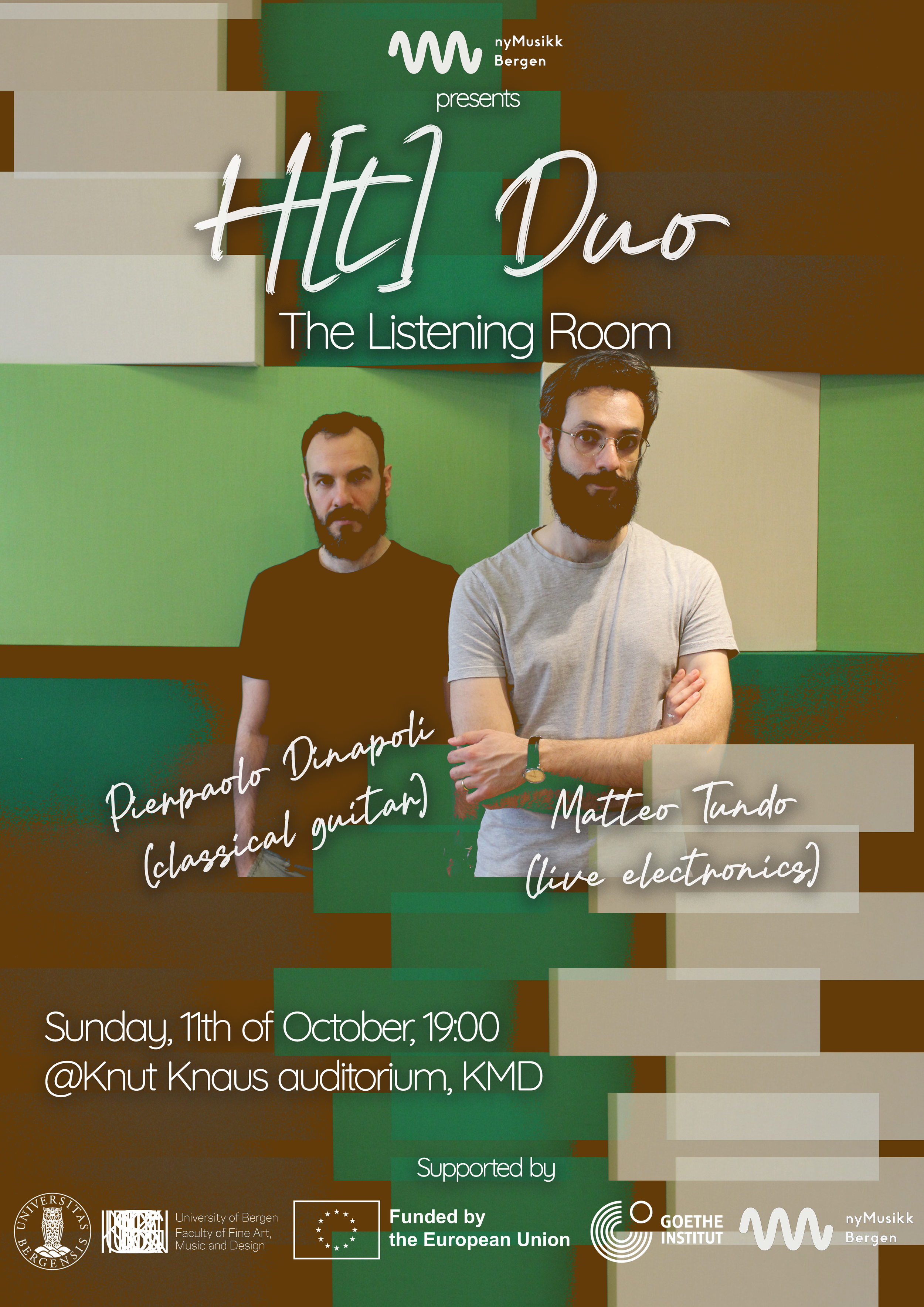
The Listening Room - H[t] DUO
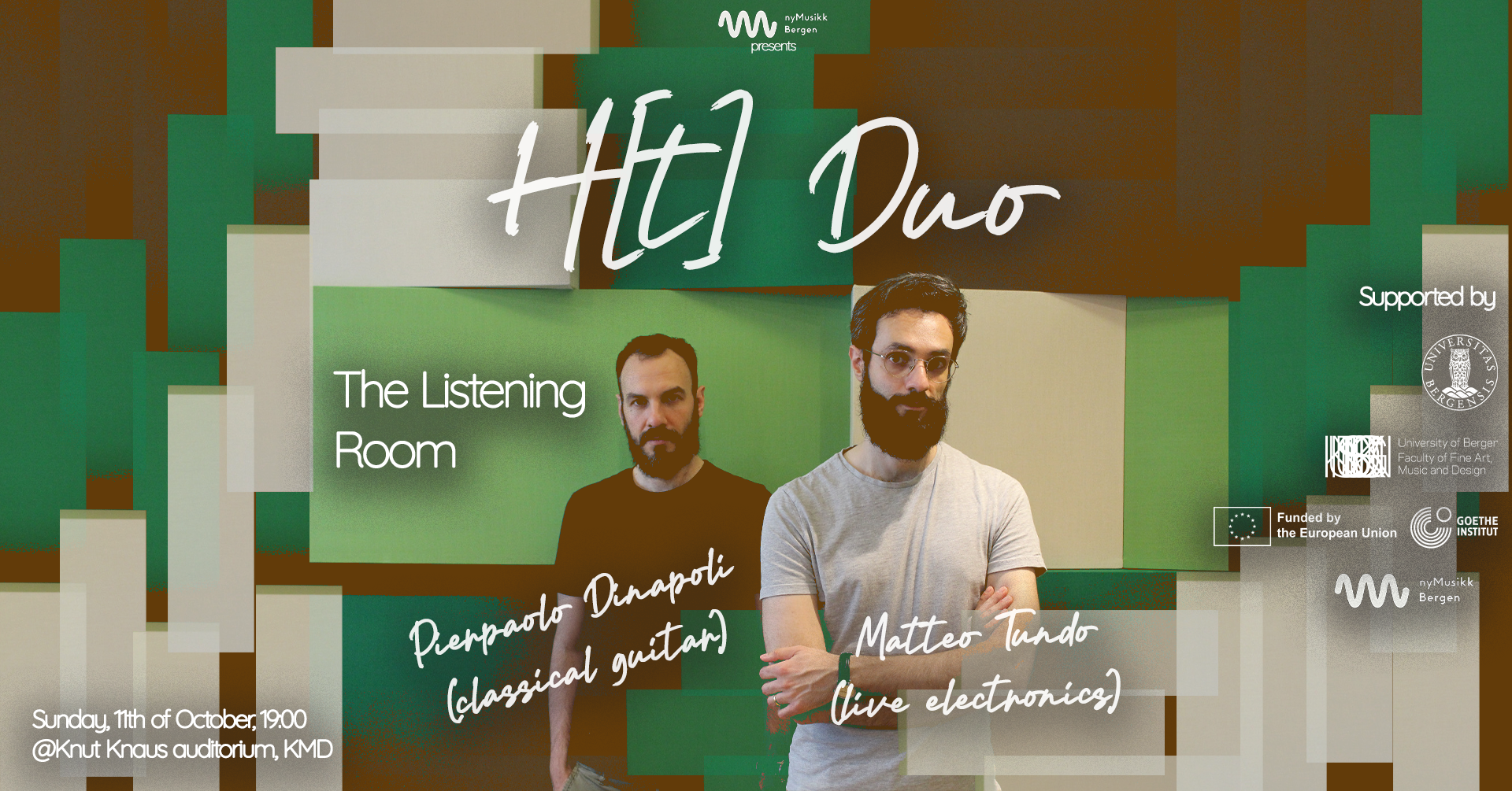
h[t] duo
H[t] Duo was born from the encounter between classical guitar and live electronics. Pierpaolo Dinapoli and Matteo Tundo explore what happens when the physicality of an acoustic instrument interacts with real-time electronic processes, shaping performances in which electronics are played, transformed, and diffused live.
On stage, the focus is on the interaction between the two performers and the sound space around them: microphone placement and spatialization become compositional tools, creating immersive environments.
The duo has performed at festivals and research centers in Italy, Austria, Germany, and Canada, including Out of the Ordinary (Konstanz), Fondazione Piseri (Milan), Modena Contemporanea, Signal to Noise Festival (Pergine Valsugana), Alte Schmiede (Vienna), CIRMMT and Université de Montréal.
H[t] Duo is also a founding member of Manifattura Digitale del Suono, a platform dedicated to new music research and production.
Program
Talia (2024); Maria Vittoria Agresti
Talia, for guitar and live electronics, unfolds around a continuous downward motion, made possible by the instrument’s scordatura, which leads progressively into ever lower registers. This “infinite glissando”, evoking a perpetual fall, contrasts with a cyclical electronic ostinato that runs throughout the piece. The dialogue between the fluidity of the descent and the static nature of the electronics creates a constant tension, drawing the sound towards remote and rarefied territories.
Fotografiar el mar (computer music design by Pierpaolo Dinapoli) (2026); David Antunez Rodriguez
The movements of this cycle are not fixed sonic photographs, but open scores: guidelines for capturing different snapshots at each performance, in keeping with the unpredictable nature of feedback. A common thread runs through them: blurring the boundaries between feedback, classical guitar and live electronics, inspired by the dialogue between Barthes’s punctum and Calvino’s Palomar.
Where hands fall into breath (computer music design by Tommaso Rosati) (2025); Nicoletta Andreuccetti
Sixty years ago, Asimov imagined organic machines and mechanical humans. Today, neuroprosthetics, neural networks and intelligences capable of learning are dissolving the boundary between nature and artifice: no longer imitation, but metamorphosis. Where Hands Fall into Breath inhabits this threshold. The instrumental gesture, reduced to its essentials, is reconfigured through its encounter with a digital breath generated through physical modelling synthesis. Acoustic and virtual bodies permeate one another, taking on new forms and rhythms. Everything becomes unstable, surreal, yet possible.
et ego (2017); Daniela Fantechi
et ego, for guitar and live electronics foresees the use of two piezo microphones, placed on the soundboard of the guitar to amplify the instrument, allowing for the production of very subtle sounds both on the strings and on the soundboard. This allows for a percussive use of the guitar, and the building up of a pitchless percussive structure, through very small gestures of hitting, scraping, striking. Progressively the percussive pace starts to slow down, opening a more harmonic window, letting emerge as an inner musical memory a distant, but recognizable, fragment by Gesualdo da Venosa (1566-1613), taken from Tristis est anima mea, in Tenebrae Resposories for Maundy Thursday.
Fray (2026); Stylianos Dimou
Fray investigates the threshold where the classical guitar’s physical immediacy begins to disintegrate. The piece draws its raw material from mechanical gesture, percussive contact, and rhythmic friction—the grain of wood under pressure, the scrape of strings, the sharpness of attack. These tactile events form a vocabulary of recursive motion, where repeated actions gradually erode their own clarity and reveal hidden layers within the instrument’s sound. The live electronics function not as an external gloss but as an active agent of distortion, mutation, and subversion. They electrify the guitar’s acoustic reality, twisting familiar resonances into rusted timbres, stretching harmonics into hollowed echoes, and generating hybrid sonic figures that oscillate between the mechanical and the spectral. As the music unfolds, the guitar and electronics fray into each other: rhythmic impulses blur into noise, percussive cracks blossom into resonant afterimages, and fragile tones are bent into unfamiliar shapes. Fray traces this process of unraveling—where sound sheds its identity and re-emerges as a charged, electrified presence.